
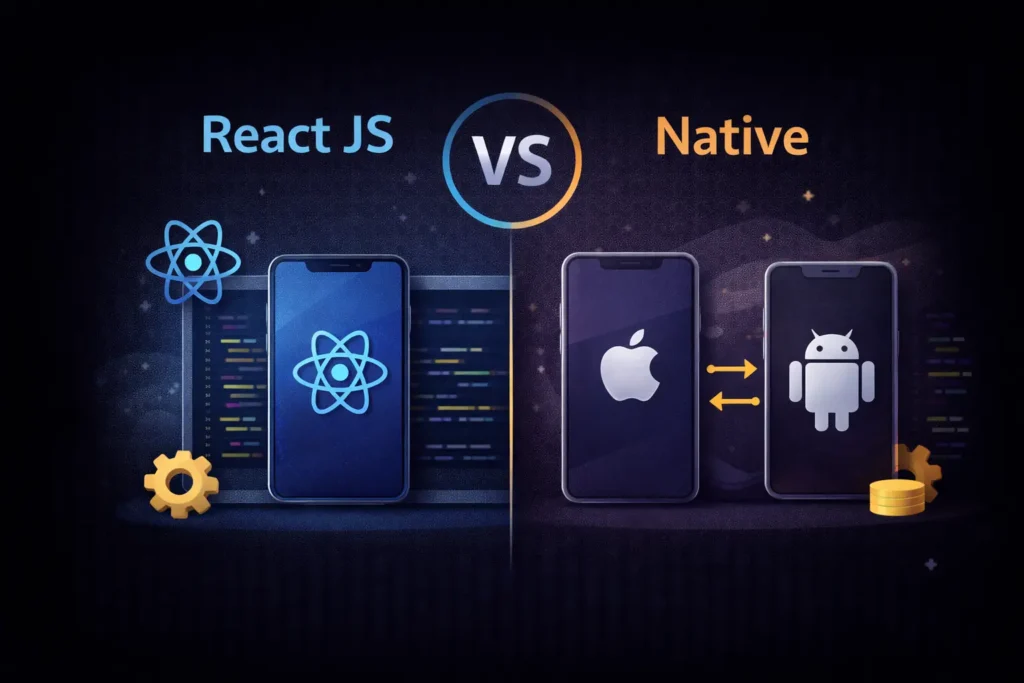
When students start learning development, one question always creates confusion — react js vs native. Many beginners hear different opinions on YouTube, blogs, and social media. Some say React JS is best, while others say React Native is the future.
When I was also a student, I had the same confusion. I knew basic JavaScript, but I didn’t understand which path to choose. That is why I decided to properly understand react js vs native step by step.
In this article, I will explain everything in very simple English, with examples, stories, and clear points so that any beginner can understand easily.
My Story: Why I Started Searching React JS vs Native
When I started learning coding, my goal was simple — I wanted to build real projects. I searched online and saw two technologies again and again: React JS and React Native.
At first, I thought both were the same. But slowly, I realized that many students are confused because they don’t understand the base difference.
During my research on react js vs native, I noticed a few common problems:
- Tutorials explained too fast
- Most articles used difficult English
- Many blogs assumed prior knowledge
- No real-life explanation was given
Because of this, beginners feel lost very early.
What Is React JS?
React JS is a JavaScript library created by Facebook. It is mainly used to build web applications that run inside a browser like Chrome or Firefox.
React JS helps developers create fast and interactive websites using reusable components. It focuses only on the frontend part of a website.
In simple words, React JS is used when you want to build websites.
React JS is mainly used for:
- Company websites
- Admin dashboards
- E-commerce frontend
- Single Page Applications
- Web-based SaaS platforms
When we compare react js vs native, React JS clearly belongs to web development.
What Is React Native?
React Native is a framework also created by Facebook, but it is used to build mobile applications instead of websites.
With React Native, developers can create Android and iOS apps using JavaScript. The code does not run inside a browser. Instead, it connects directly with mobile native components.
This is why the word “Native” is used.
React Native is mainly used when your final product is a mobile app.
React Native is used for:
- Android apps
- iOS apps
- Startup MVP apps
- Cross-platform mobile applications
This difference is very important when understanding react js vs native.
React JS vs Native: Simple Meaning
Many students get confused because both technologies use React and JavaScript. But the output is completely different.
In very simple terms:
- React JS creates websites
- React Native creates mobile apps
Even though logic looks similar, the platform is not the same.
React JS vs Native in one view:
- Same JavaScript language
- Same component-based concept
- Same hooks logic
- Different final output
This is the basic foundation of react js vs native.
React JS vs React Native (Basic Comparison)
To understand react js vs react native clearly, let’s compare them side by side.
| Feature | React JS | React Native |
|---|---|---|
| Used for | Websites | Mobile apps |
| Runs on | Browser | Mobile device |
| Uses HTML | Yes | No |
| Styling | CSS | StyleSheet |
| Output | Web page | Android / iOS app |
| Learning level | Beginner | Intermediate |
This table helps beginners visualize the difference easily.
Additional Read: React Native Paper Dropdown
Real-Life Example of React JS vs Native
Let’s understand react js vs native with a real example.
Imagine you want to build an online food delivery system.
If you use React JS:
- You build a website
- Users open it in browser
- Works like Swiggy website
If you use React Native:
- You build a mobile app
- Users install it from Play Store
- Works like Swiggy mobile app
Same idea, same logic — but different platform.
Code Example: React JS vs Native
Even though both look similar, the components are different.
React JS example:
function App() {
  return <h1>Hello Website</h1>;
}
React Native example:
import { View, Text } from 'react-native';

function App() {
  return (
    <View>
      <Text>Hello Mobile App</Text>
    </View>
  );
}
Key difference:
- React JS uses HTML tags
- React Native uses native components
This is a core concept in react.js vs react native.
React Native vs React JS: Learning Difficulty
Students often ask which one is easier.
React JS is easier for beginners because it works visually in the browser. You can instantly see changes.
React Native feels slightly harder at the beginning because mobile setup takes time.
Learning comparison:
- React JS
- Easy debugging
- Simple setup
- Fast learning
- React Native
- Android/iOS setup required
- Emulator configuration
- Mobile-specific concepts
That’s why many teachers suggest starting with React JS before moving to Native.
React vs React Native vs React JS (Big Confusion Solved)
Many beginners think these are three different things, but they are connected.
Let’s simplify:
- React → core concept
- React JS → React for web
- React Native → React for mobile
So when people say react vs react native vs react js, they are actually talking about usage, not competition.
Which One Should Students Learn First?
From my personal experience and from seeing many learners struggle, the best order is:
- Learn JavaScript basics
- Learn React JS properly
- Then learn React Native
Why this order works:
- React JS teaches fundamentals
- Concepts transfer easily
- React Native becomes simpler
- Confidence increases
Understanding react js vs native early saves a lot of confusion later.
Career Scope: React JS vs Native
Both technologies have strong job demand.
React JS jobs:
- Frontend developer
- Web developer
- UI developer
React Native jobs:
- Mobile app developer
- Cross-platform developer
If you know both:
- Higher salary chances
- More project opportunities
- Startup-friendly skillset
Companies prefer developers who understand react js vs native clearly.
When to Choose React JS
Choose React JS when:
- You want to build websites
- SEO is important
- Project runs on browser
- You want fast development
React JS is perfect for frontend-focused careers.
When to Choose React Native
Choose React Native when:
- You want mobile apps
- One codebase for Android and iOS
- Startup MVP development
- App-based business idea
React Native saves development time and cost.
Final Comparison Summary
| Point | React JS | React Native |
|---|---|---|
| Platform | Web | Mobile |
| Best for | Websites | Apps |
| Difficulty | Easy | Medium |
| Career scope | High | High |
| Beginner friendly | Yes | After React JS |
Final Thoughts
The question react js vs native is not about which one is better. It is about what you want to create.
If your goal is websites — learn React JS.
If your goal is mobile apps — learn React Native.
For students, the smartest path is:
React JS first → React Native next.
Once you understand the difference between react js vs native, your learning journey becomes much easier and more confident.